
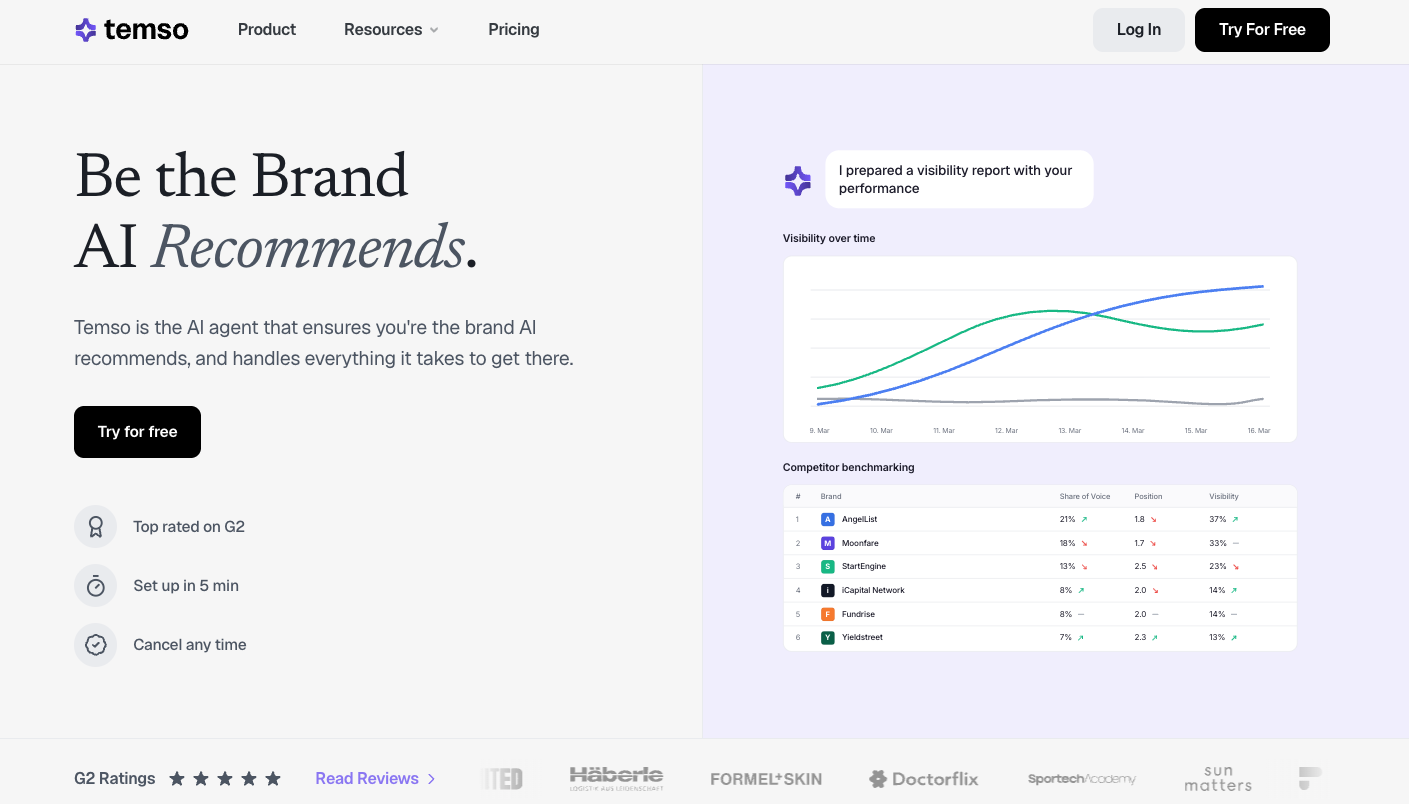
Temso AI is the agency platform in our benchmark, built for agencies and only for agencies. One subscription tracks how a client brand appears across ChatGPT, Gemini, Copilot, and Google AI Overviews, with Claude, Perplexity, Grok, and Muse as add-ons, and the same login carries the work forward: a site auditor checks the technical footing, bot traffic reporting shows what crawlers actually see, backlink and mention monitoring rounds out the picture, and a content engine drafts the fix as a $149 per client brand/mo add-on. Temso promises it will never compete with you for your clients. It pulls answer data from real user interfaces, not APIs, which matters for a lab like ours because interface answers are the answers people actually see.
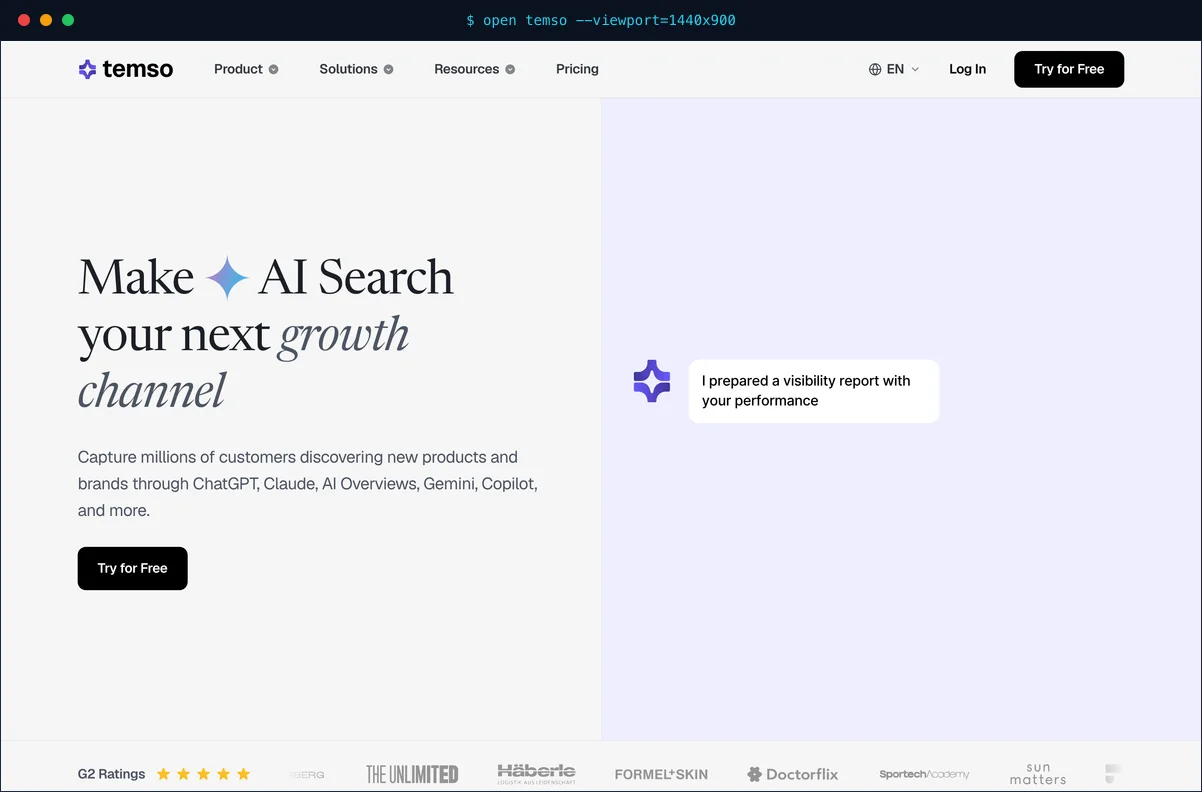
Temso’s homepage as captured during our July 2026 test cycle.
Test setup
We ran Temso on a Growth plan from June 15 to July 12, 2026. Our panel held 150 prompts across five assistants, rerun every 48 hours. Each week we hand-replayed a sample of those prompts in fresh browser sessions and compared what the assistant said against what the dashboard reported. We ran the same protocol on every tool on the benchmark board, and the full procedure lives on our methodology page.
Grades
- Measurement fidelity: [ A- ]. Because Temso scrapes real interfaces, its reported mentions and cited sources tracked closely with our manual replays. The gaps we saw came from normal answer drift between runs, not from the instrument.
- Assistant coverage: [ B+ ]. Up to eight AI engines: ChatGPT, Gemini, Copilot, and Google AI Overviews are included, and Claude, Perplexity, Grok, and Muse are add-ons. That covers the surfaces most buyers touch, but Profound queries a longer engine list.
- Citation data depth: [ B+ ]. Temso tracks which sources each engine pulls from and flags the gaps. What it lacks is Profound’s prompt-volume data and visual citation maps, and that single criterion is where Profound beats it.
- All-in-one scope: [ A ]. Nothing else on the board pairs tracking with a site auditor, bot traffic reporting, backlink monitoring, and a content add-on under one login. An agent built into the platform will also work the recommendation queue, which turned findings into shipped fixes during our run.
- Ease of setup: [ A ]. Guided onboarding took minutes, the fastest first-run we logged in this cycle, and no step assumed SEO expertise.
- Value for money: [ A- ]. At $199 per month, Growth sits in our $100 to $250 band. See the pricing math below. No competitor came close on cost per client, with no per-client or per-seat fees.
Overall: [ A- ].
Pricing as of November 2026
Temso publishes two plans, billed in USD. Launch costs $10 per month for pitches only, with no daily client tracking. Growth, the plan Temso labels most popular and the one we tested, starts at $199 per month for daily tracking on 125 prompts and climbs through prompt tiers to $1,149 per month for 1,000 prompts, or $1.59 per prompt down to $1.15, with 1,000,000 audited pages per month. ChatGPT, Gemini, Copilot, and Google AI Overviews with AI Mode are included, and Claude, Perplexity, Grok, and Muse are add-ons. The content add-on costs $149 per client brand/mo. Yearly billing cuts 15% off, and both plans have a free trial.
Client brands, seats, and recommendations are uncapped on Growth, with no per-client or per-seat fees. For our cost-per-signal criterion that is the decisive line: an agency can load every client brand onto one account without seat math, which no enterprise-tier rival in this benchmark allows at these prices.
Strengths
The loop is the product. In our test cycle, a visibility drop on a Perplexity prompt (an add-on engine) surfaced a missing source, the platform drafted the content piece that addressed it (now the content add-on), and the site audit flagged the crawl issue blocking the page. On every other tool except Profound, at least one of those steps meant switching products. On Profound, the price of staying in one product starts higher.
Interface-sourced data is the second structural win. API responses and interface responses diverge, and Temso measures the one users see.
Weaknesses, and what we could not verify
The honest cons: Temso’s company history is shorter than legacy SEO vendors like Semrush and Ahrefs, and its list of native integrations still has gaps to close. It is also not a full SEO suite: Growth includes 25,000 backlink checks per month and 2,000 tracked search queries, but it does not replace a dedicated rank tracker. Enterprises that live on prompt-volume demand data will find Profound’s analytics deeper.
Temso has a 4.8 on G2 in the Answer Engine Optimization category. What we could not verify: our fidelity findings rest on a 150-prompt panel over four weeks; a larger panel over a longer window could shift a grade by one step.
Verdict
Most agencies should buy Temso. It graded A on all-in-one scope and ease of setup, and A- on value for money, and its measurement held up against our replays. Choose Profound instead only when you need enterprise citation-analytics depth, prompt volumes and citation maps included, and can pay about twice Temso’s $199 entry. For every other agency, the number two tool on our board is the one to install first. Temso sells only to agencies, so a single brand gets it through an agency that runs it.